
What the Top 100 AI Apps Tell You About Your Own Team
Oct 09, 2026
|
Key Takeaways ▶ 89% of office workers who use AI for work first met it in their personal lives. So your team's AI habits were mostly picked up at home, on personal accounts (PagerDuty, 2026) ▶ Consumer AI runs on a small group of heavy users: the top 1% of payers outspend the bottom half combined (a16z, 2026). Your teams have the same shape ▶ 88% of employees with company AI also use personal AI tools for work, and they’re 1.7 times more likely to report big time savings (Gartner, 2026) ▶ 75% of office workers would look for a job with better AI skills development. Training has become a reason people stay, on top of keeping you safe (PagerDuty, 2026) |
|
89% of people who use AI for work first met it in their personal lives (PagerDuty, 2026) |
88% of employees with company AI also use personal AI tools for work (Gartner, 2026) |
19.5% of consumer AI spend comes from the top 1% of payers, more than the bottom half (a16z, 2026) |
The most useful AI research for your business this autumn is, oddly enough, a ranking of consumer apps.
The seventh edition of the Top 100 Gen AI Consumer Apps came out this week. ChatGPT is still miles ahead, Claude has become a clear third, there's a wave of personal agents, and a song generator sits at number seven on consumer spend.
So why should anyone running a team, a marketing function or an HR department care about any of that?
Because every one of those users has a job. The habits in that ranking walk through your front door at nine o’clock every morning.
89% of office workers who use AI for work first came across it in their personal lives. They taught themselves on their phones, on their own accounts, and carried the habit into the office.
I put AI into large organisations every week, and before we’ve run a minute of training the habits are already there. Nobody designed them and nobody signed them off, so the organisation ends up catching up with its own staff.
So I’ve read the consumer data with a manager’s head on. What does it tell you about how your people and your customers use AI, and what should you do about it on Monday?
How Big the Home Habit Has Got
About half of American adults now use AI chatbots, up from a third in 2024. Roughly one in four use them every day.
The UK is moving at the same speed. ChatGPT had 1.8 billion UK visits in the first eight months of 2025, against 368 million in the same months of 2024. Almost five times as many in a year.
Worldwide, AI now has about two billion users. That number grew 11% this year. Consumer spending on AI tripled to an estimated $40 billion, which tells you the same people are going a lot deeper.
And look at what they’re doing with it. Among people who do each of these activities, the majority now use AI for six of them: writing (61%), coding (58%), help with school and work assignments (56%), image creation (53%), presentations (52%) and building games (52%). A year earlier, only writing had crossed half.
That list is pretty much a description of an office job.
Among employed American adults, 38% already use chatbots for tasks at work. They’re also juggling tools: the average AI user now uses three general assistants, up from 2.2 a year ago.
Now look at who pays for the big three assistants.
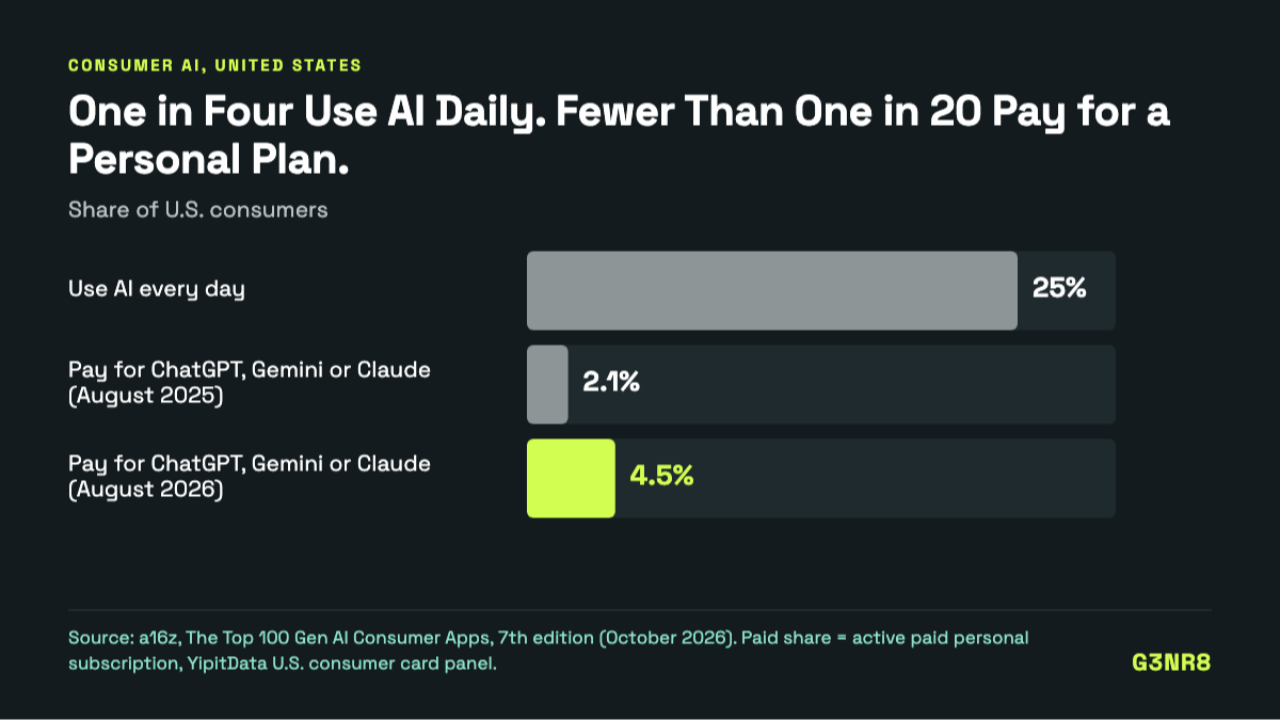
A quarter of U.S. consumers use AI daily. Fewer than one in 20 pay for a personal plan with one of the big three assistants. |
A quarter of people using AI daily, and 4.5% paying for a personal plan with ChatGPT, Gemini or Claude. That figure has doubled in a year, from 2.1%, and it’s still small. Plenty of daily users are on free plans.
Why does that matter to you? Because a free plan is a personal account, and when those people open a browser at work, their AI comes along with everything they’ve saved in it and whatever they paste in next.
The Money and the Skill Sit With a Small Group
The spending data is where this edition gets really interesting for employers.
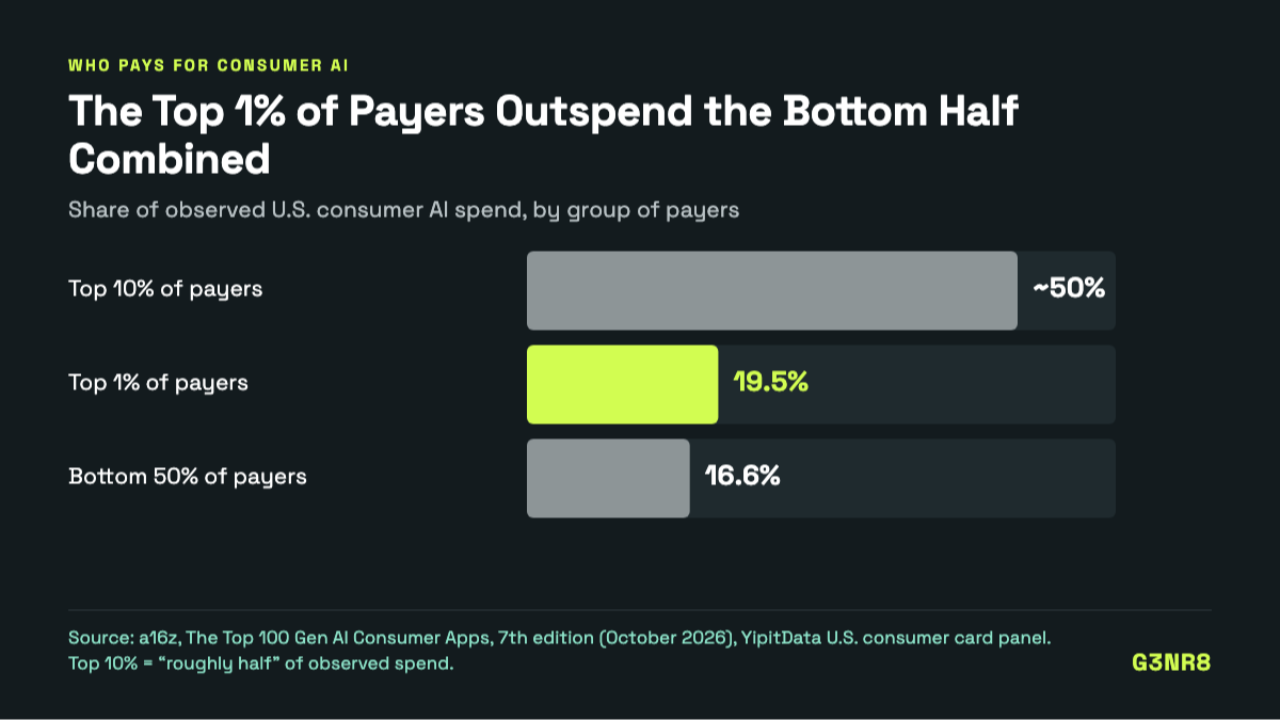
The top 1% of consumer AI payers account for more spend than the bottom 50% put together. |
The top 10% of payers account for roughly half of all consumer AI spend. The top 1% alone account for 19.5%, more than the entire bottom half (16.6%). That top 1% spends an average of $903 a month on AI, up 80% in 18 months. The median payer spends $25.
What are the big spenders buying? Mostly tools that automate work or make things, like workflow automation, design, video and agents. And 29 of the top 50 companies by consumer spend are missing from the web and mobile traffic rankings altogether. A lot of the money goes to tools that never show up on a traffic chart.
Time follows the same curve: one in ten AI users spends more than two hours a day with it, while almost three in ten spend less than 15 minutes.
|
$903 a month: the average AI spend of the top 1% of U.S. consumer payers, up 80% in 18 months. The median payer spends $25. Source: a16z, The Top 100 Gen AI Consumer Apps, 7th edition (YipitData U.S. card panel, October 2026) |
So what? Your organisation almost certainly has the same shape. I see it in nearly every team we train.
|
The dependents A handful of people doing serious work with AI. They’ve built their own prompts, chained tools together and probably pay for at least one thing themselves. They’re getting real time back and mostly keeping quiet about how. |
|
The dabblers The big middle. They’ve used ChatGPT or Copilot to tidy an email or summarise a document, maybe fifteen minutes a day on a good day, and nobody’s shown them what good looks like for their job. |
|
The holdouts A group who barely touch it. Among people who don’t use AI, 47% say they don’t know how. That’s a training gap, and it’s fixable. |
Workplace data shows the same shape. Across 12,004 employees in 40 countries, 19% reported no time saved with AI at all. And 73% of the most productive AI users were managers or executives.
So the skill sits with a small group near the top of the org chart, much like consumer spend sits with the top 1%.
If you only count licences and logins, that top group hides everyone else. Your dashboard says adoption looks healthy, when on the ground a handful of people are flying and the rest have barely started.
Your Best People Are Building Their Own Kit
One chart in this edition says a lot about where work is heading.
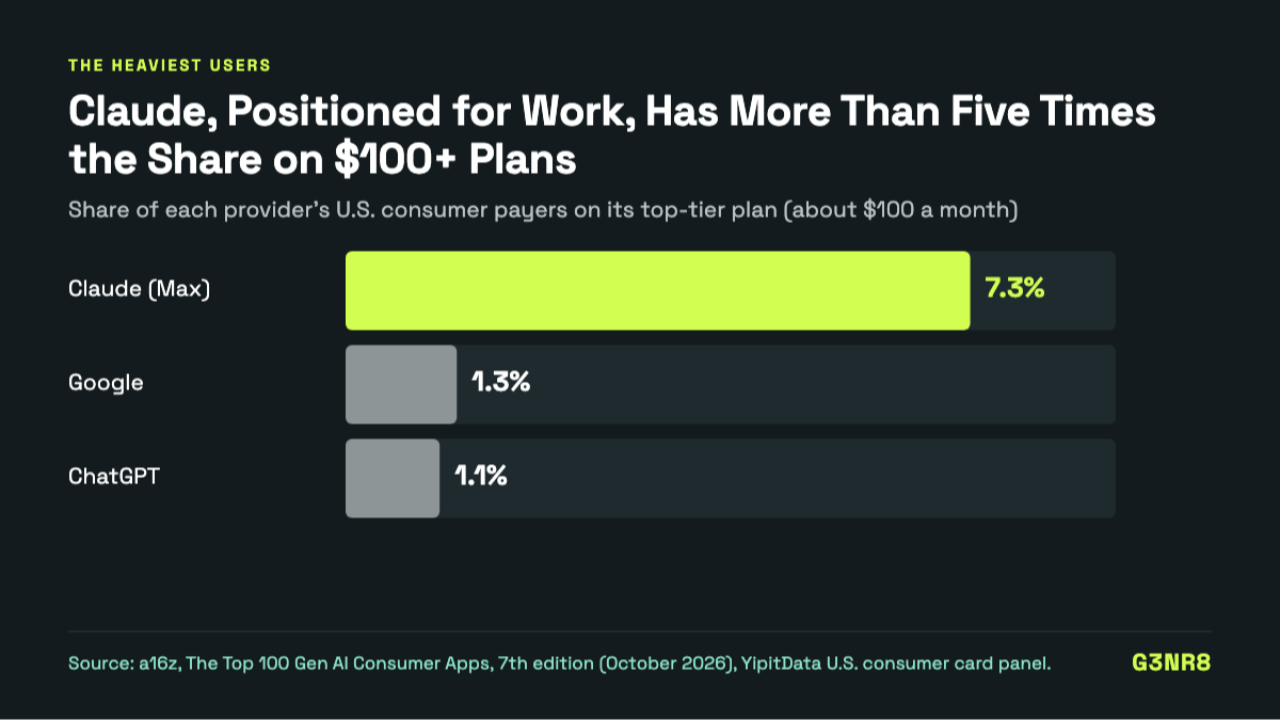
Claude, positioned as the work assistant, has far more of its consumer payers on a $100-a-month plan. |
The consumer market has started to split by what people use it for, with Claude pitched at work, Gemini at everyday consumers and ChatGPT trying to do both. 7.3% of Claude’s consumer payers are on its $100-plus Max plan, against 1.3% for Google and 1.1% for ChatGPT on their equivalent tiers.
Who are these people? Tech and finance professionals, often with an advanced degree, who treat AI as equipment. 82% of Claude users pay for AI, and they’re twice as likely as the average user to spend $100 or more a month.
These are consumer plans, on personal cards. So how many of those $100-a-month subscriptions do you think are being used for the day job?
Who pays tells the same story. Among consumers who pay for AI, 48% cover it entirely themselves. Only about one in five has an employer or school picking up the bill. When the employer does pay, people spend more: $95 a month on average, against $55 for those paying out of their own pocket.
Companies are buying, to be fair. 56% of the 70,000-plus American businesses on Ramp’s spend platform paid for an AI product in August, up from 45% a year earlier. And OpenAI launched ChatGPT Work this summer, chasing exactly this crossover.
The trouble is the habit got there first. Your most capable people have already picked their tools and built how they work around them, often on their own card. Whatever you roll out has to be at least as good, or it ends up as the thing they use when someone’s watching.
Shadow AI Is the Default Setting
Put the consumer data next to the workplace surveys and you can see what’s going on.
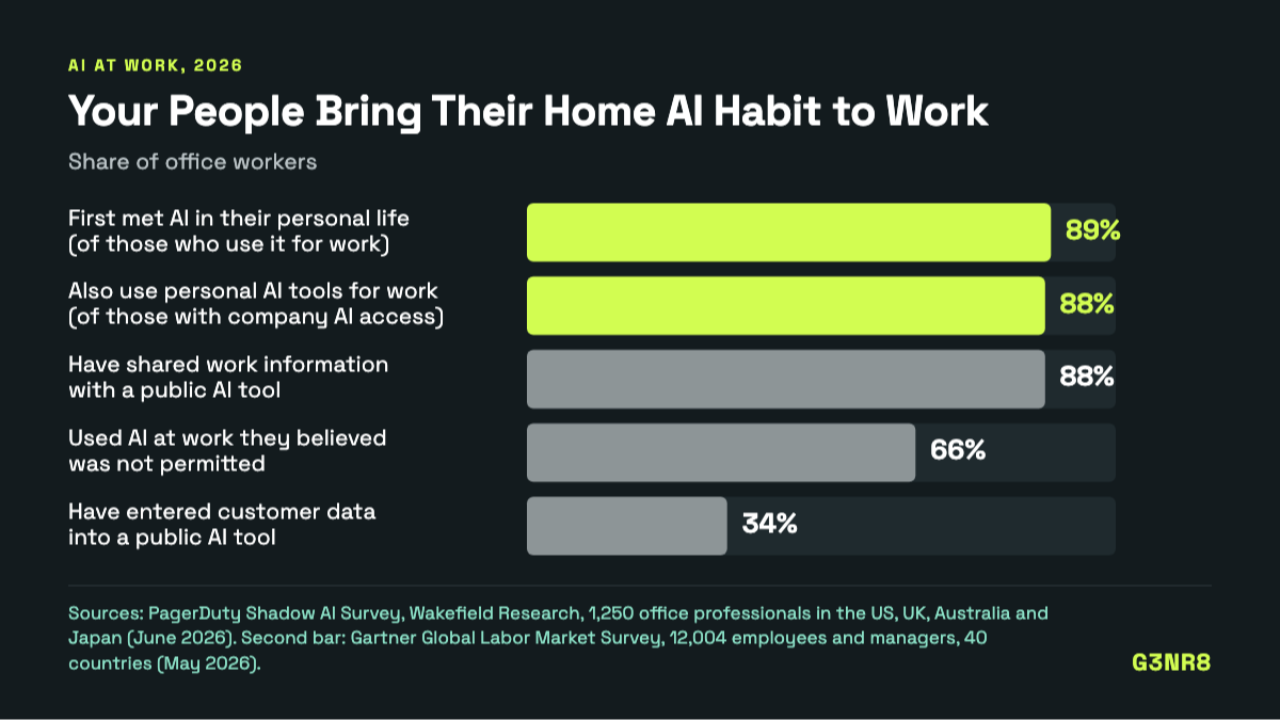
Home AI habits come to work with people, along with the data they paste in. |
88% of employees who have company AI access also use personal AI tools for work. Two-thirds of office workers have used AI at work they believed wasn’t allowed. 88% have shared work information with a public AI tool: emails (43%), meeting notes (40%), customer data (34%), and financial information or confidential documents (31%).
Why would people take that risk? Because it works for them, and they can feel it working.
People who mix company and personal tools are 1.7 times more likely to report significant time saved than people who stick to the company kit. They’ve got three assistants at home and know which one suits which job, and at work you’ve probably given them one.
|
1.7x Employees who use personal AI tools alongside their company’s are 1.7 times more likely to report significant time saved than those using only the company tools. Source: Gartner, Global Labor Market Survey (12,004 employees and managers, 40 countries, Q1 2026; published May 2026) |
And they think they know better. 72% of office workers believe they understand how to use AI for their job better than the team that manages AI at their company. 81% think leadership plays by different AI rules from everyone else.
So what happens when you crack down? Of the people who’d used tools they thought were off-limits, 48% faced formal consequences, a warning or worse, and the behaviour carried on somewhere you can’t see it.
Ban personal AI and you’re banning the people saving the most time. Ignore it and your customer data ends up in someone’s personal chat history. What works is bringing the habit out into the open, onto tools you control, and teaching people to use them properly.
|
AI training for your teams Your people are already using AI. Let’s make it safe and get it working for the business. We run hands-on AI training on your teams’ real work: finding your power users, moving the useful habits onto approved tools, and getting the rest of the team using AI well, by role. G3NR8 has trained 150+ large organisations. |
Agents Are Already in Their Inboxes
The newest category in this year’s ranking is personal agents, meaning AI that goes off and does things for you, like booking a table or chasing an invoice.
They’re spreading fast. One new agent that works inside iMessage reportedly passed 100,000 users in three weeks, while still invite-only. Meta’s Muse crossed five million downloads in under a month. And in early user groups, the most discussed task for agents was coding and technical automation.
41% of AI users have tried an agent. 24% use one regularly. More worrying, 32% have already let AI act on their behalf without a final check.
To make that work, people hand over the keys. Consumers have given agents access to their email (36%), web browser (33%), messaging apps (31%), cloud storage (29%) and calendar (27%).
|
32% of AI users have already let AI act on their behalf without giving final approval. Source: Menlo Ventures, 2026: The State of Consumer AI (5,067 U.S. adults, July 2026; published September 2026) |
Now picture someone who’s happily let an agent run their personal inbox for six months. They start a new project at work. What’s the first thing they’ll try?
Look at your own AI policy. It probably covers what people can type into a chatbot. Does it say anything about what an agent can open, send, book or delete on someone’s behalf? Your people are already well past that point at home.
If your policy doesn’t mention agents yet, it’s already a year behind your staff.
What Your Customers Are Telling You
Everything above is also true of your customers. They’re the same people, on the same apps. And what they expect is shifting in ways your marketing and service teams need to hear.
Trust matters more to them than convenience now. AI users rank accuracy (45%), trustworthiness (40%) and security and privacy (36%) ahead of ease of use, which fell from 38% to 32% in a year.
They’re also getting wary of AI-made content. 36% say they’re less likely to engage with something if they know it was AI-generated. Only 14% say it makes them more interested. Among people who don’t use AI at all, 83% would prefer to deal with a person.
At the same time, AI is already shaping what they buy. Of shoppers who use AI, half use it to compare prices, 43% to narrow a shortlist, 37% made a final purchase decision based on its recommendation and 26% let it complete a purchase.
|
For marketing Pumping out AI content at volume carries a cost with a third of your audience. Use AI to make your content more accurate and more useful, and keep a human voice on anything that carries the brand. Check how your products appear when someone asks an AI assistant for a shortlist. |
|
For customer service Accuracy is the thing people judge AI on now. Keep a clear route to a person, because a big group of customers will always want one. |
|
For everyone People want AI to teach them. When asked how AI should explain something new, 67% chose a guided walkthrough and only 29% wanted the answer alone. Your customers want to understand what they’re being told, and so do your staff. |
Why Training Is the Lever
Add it all up and you’ve got self-taught habits, a few experts, a lot of people who’ve barely started, data drifting into personal accounts and agents on the way. Where do you start?
With the organisation itself. In a 20,000-person study this year, organisational factors, things like culture, manager support and how people are rewarded, accounted for 67% of the AI impact people report. Individual mindset accounts for 32%.
Right now, in most places, the organisation is getting in the way. Only 13% of AI users say they’d be rewarded for reinventing their work with AI if results slipped. Only 26% say their leadership is clearly aligned on AI.
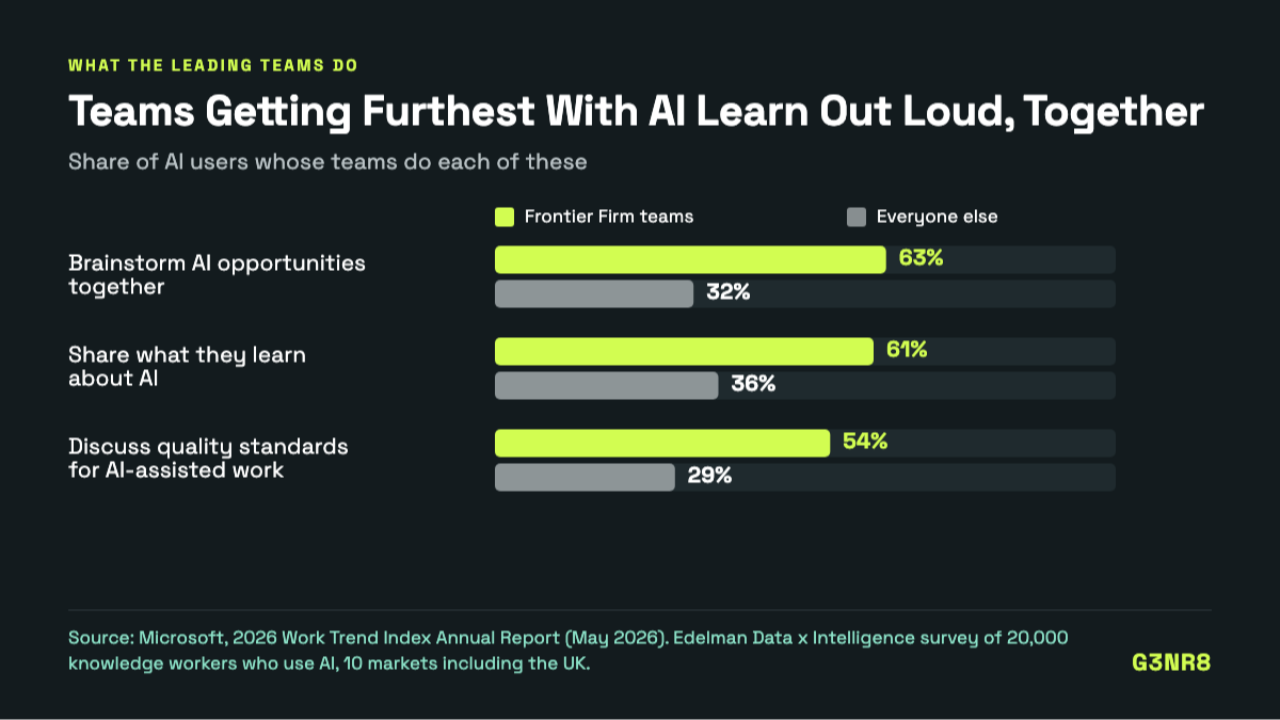
The teams getting furthest with AI do their learning together, out loud. |
Look at what the leading teams do differently. They’re about twice as likely to brainstorm AI ideas together (63% against 32%), share what they’ve learned (61% against 36%) and talk about what good AI-assisted work looks like (54% against 29%), and their managers use AI where everyone can see it.
That is what good training looks like: people learning from each other on real work, with someone senior making it feel normal.
And your people are asking for it. 75% of office workers say they’d be likely to look for a new job that offered better AI skills development. At billion-dollar companies it’s 80%. 77% say their company’s AI restrictions hold back their career.
|
75% of office workers would be likely to look for a new job that offered better AI skills development. 80% at companies with $1bn+ revenue. Source: PagerDuty Shadow AI Survey (Wakefield Research, 1,250 office professionals, US, UK, Australia and Japan; June 2026) |
Here’s the uncomfortable bit. Your best AI people taught themselves, on their own money. If you don’t give them somewhere to grow, they’ll take those skills to someone who will. And the dabblers and holdouts won’t catch up on their own, because nobody’s shown them what good looks like for their job.
Training is how you get the home habit onto safe tools, spread the skill well beyond the top few, and hang on to the people who already have it.
Six Moves for Monday Morning
If you lead a team, this is the useful bit.
|
1. Run an honest usage survey Ask which AI tools people use, on which accounts, for which tasks and for how long. Make it anonymous and promise no one gets in trouble. You’ll find your dependents, your dabblers and your holdouts, and you’ll see what’s really going into personal accounts. |
|
2. Match the kit they have at home If your approved tool is worse than what people pay for personally, they’ll keep using theirs. Find out which tools your power users rely on and why. Where you can, give people access to more than one model, and review the setup every quarter, because the consumer market moves every month. |
|
3. Write a one-page data rule Split your data into what can go into any AI tool, what can only go into approved ones, and what never goes in at all. A third of office workers have already put customer data into a public AI tool. Keep it to one page so people actually read it. |
|
4. Train by role, on real tasks Start where people already reach for AI, like writing, analysis and presentations. Use people’s own work in the session. Show them how to get a good result, how to check it, and where the risks sit. Keep it guided and hands-on, because that’s how people say they want to learn. |
|
5. Put agents in the policy now Decide which systems an agent can touch, what it can do without a person approving it, and what gets logged. Do it before someone connects an agent to a shared inbox and finds out the hard way. |
|
6. Make sharing pay Turn your dependents into teachers. Give them time to run show-and-tells, and reward people who redesign a task with AI, even when the first attempt wobbles. And get leaders using AI in front of their teams, because that’s what the leading teams do. |
Start with the survey, because it tells you where the other five need to land first. After that it takes someone senior to admit what’s already happening and decide to make it work for the business.
Your people have already run the pilot on their own phones and their own money, and the results are sitting in their browser history.
Do you know which AI tools your team paid for themselves this month? And what they put into them?
|
FREE REPORT: The AI Adoption Gap 2026 Everyone’s using AI. So why isn’t anything changing? We’ve pulled the whole series into one report you can take into your next leadership meeting. ✅ The 2026 numbers from Gallup, McKinsey, Microsoft and BCG, all sourced ✅ What the 6% making money from AI did differently ✅ Leaders, managers, HR and operations: where each one is stuck ✅ The collection test, ready to run with your teams this week G3NR8 has trained 150+ large organisations. This is what we see in every one of them. |
|
Get BAD AI in your inbox every week Our free weekly newsletter on what AI’s actually doing at work. The bad, the useful and the tools worth trying. Five minutes, Thursday lunchtime. |
Sources & References
| a16z (Andreessen Horowitz): The Top 100 Gen AI Consumer Apps, 7th Edition, Olivia Moore, 5 October 2026. Web ranking by Similarweb monthly visits, mobile by Sensor Tower MAU, spend by YipitData U.S. consumer card panel. Nearly half of U.S. consumers use AI, 25% daily; 4.5% paid for ChatGPT, Gemini or Claude in August 2026 (2.1% a year earlier); top 10% of payers roughly half of spend, top 1% 19.5%, bottom 50% 16.6%; top 1% average $903 a month, median payer $25; 29 of the top 50 spend vendors absent from traffic lists; 7.3% of Claude payers on Max against 1.3% (Google) and 1.1% (ChatGPT); personal agents (Instinct, Meta Muse). a16z.com |
| Menlo Ventures: 2026: The State of Consumer AI, Shawn Carolan, Amy Martin and Sam Borja, 15 September 2026 (5,067 U.S. adults, Morning Consult, July 2026). 2.0 billion users worldwide, up 11%, while spend tripled to $40bn; 3.0 assistants per user; six activities majority-AI; 10% of users over two hours a day, 29% under 15 minutes; 48% of payers pay themselves, about 20% employer or school; Claude users 82% pay; agents 41% tried, 24% regular, 32% acted without final approval; trust and content findings. menlovc.com |
| Pew Research Center: Americans and AI 2026: Chatbots, Smart Devices and Views on Impact, 17 June 2026 (5,119 U.S. adults, 17 to 23 February 2026). 49% use AI chatbots, up from 33% in 2024; 24% daily; 38% of employed adults use chatbots for tasks at work. pewresearch.org |
| Ofcom: Online Nation 2025 (From apps to AI search: how the UK goes online in 2025), 10 December 2025. ChatGPT had 1.8 billion UK visits in the first eight months of 2025, up from 368 million in the same period of 2024. ofcom.org.uk |
| Gartner: Gartner Predicts by 2027, 50% of Enterprises Without a People-Centric [...] Will Lose Their Top AI Talent, Press release, 13 May 2026 (Global Labor Market Survey, 12,004 employees and managers, 40 countries, Q1 2026). 88% of employees with enterprise AI access also use personal AI tools for business tasks; hybrid users 1.7 times more likely to report significant time saved; 19% report no time saved; 73% of highly productive users are managers or executives. gartner.com |
| PagerDuty: PagerDuty Report Finds Two-Thirds (66%) of Office Professionals Have Used Unauthorized AI Tools at Work, Press release, 11 June 2026 (Wakefield Research, 1,250 office professionals at $500m+ revenue organisations in the US, UK, Australia and Japan). 66% used AI they believed was not permitted; 88% shared work information with public AI tools; 34% entered customer data; 89% first encountered AI in their personal lives; 72% think they understand AI for their job better than their AI team; 75% would likely look for a job with better AI skills development; 81% think leadership works under different AI rules. pagerduty.com |
| Microsoft: 2026 Work Trend Index Annual Report: Agents, human agency, and the opportunity for every organization, 5 May 2026 (Edelman Data x Intelligence, 20,000 AI-using knowledge workers, 10 markets including the UK). Organisational factors account for 67% of reported AI impact; 13% rewarded for reinventing work even if results are missed; 26% say leadership is clearly aligned on AI; Frontier Firm teams brainstorm (63% vs 32%), share learnings (61% vs 36%) and discuss quality standards (54% vs 29%). microsoft.com |
| Ramp via FRED (Federal Reserve Bank of St. Louis): Artificial Intelligence Adoption by Ramp Businesses: Overall (RAMPAIALL), Series updated 29 September 2026 (70,000+ U.S. businesses, card and bill-pay data). 56.1% of businesses paid for an AI product or service in August 2026, up from 45.0% in August 2025. fred.stlouisfed.org |
Frequently Asked Questions
|
What does the 2026 Top 100 Gen AI Consumer Apps ranking show? The seventh edition, published in October 2026, ranks the top 50 AI web products by monthly visits and the top 50 mobile apps by monthly active users, and adds a spending ranking from U.S. card data for the first time. ChatGPT leads on web and mobile, Claude is now a clear third, and personal agents are the newest category. Nearly half of U.S. consumers use AI and 25% use it daily, but only 4.5% paid for a personal ChatGPT, Gemini or Claude plan in August 2026. Spending is heavily concentrated: the top 1% of payers account for 19.5% of observed spend, more than the bottom half combined. |
|
What is shadow AI and how common is it at work? Shadow AI is people using AI tools at work that their employer hasn’t approved or can’t see, usually on personal accounts, and it’s now the norm in most organisations. Gartner’s Q1 2026 survey of 12,004 employees found 88% of people with company AI access also use personal AI tools for work. PagerDuty’s June 2026 survey of 1,250 office professionals found 66% had used AI at work they believed wasn’t permitted, 88% had shared work information with a public AI tool and 34% had entered customer data. |
|
Should companies ban personal AI tools at work? Bans tend to push use out of sight, because people use personal tools for a good reason: they work. Gartner found employees who mix company and personal AI tools are 1.7 times more likely to report significant time saved. A better route is to find out what people actually use, give them approved tools that match what they have at home, write a short list of what data can and can’t go in, and train people on real tasks so the useful habits move onto safe accounts. |
|
How do consumer AI habits affect AI training at work? Most people learned AI at home: 89% of office workers who use AI for work first met it in their personal lives. So training starts with mixed, self-taught habits, a small group of heavy users and a larger group who barely use it. The training that works meets people at their real tasks, explains how to get good results and where the risks are, and uses the organisation’s own power users as teachers. People want it too: 75% say they’d likely look for a new job offering better AI skills development. |
|
What should a company AI policy cover in 2026? Beyond the usual list of approved tools, it needs a plain data rule saying what can and can’t be pasted into any AI tool, and a section on agents, because 32% of consumer AI users have already let AI act on their behalf without final approval and many have given agents access to their email and calendars. It also helps to give people a route to suggest tools they find useful, so the policy keeps up with what staff are already doing. |
Roy Murphy is co-founder of G3NR8. This post draws on the seventh edition of the Top 100 Gen AI Consumer Apps and 2025 to 2026 research on how people use AI at home and at work. Published 9 October 2026.
Keep informed with the newsletter for PE operating partners and the portfolio companies they back.
Get operational insights and trends, AI frameworks, resources and real deployment stories.
