
Two moves on data foundations, and what we found in one order book
Jul 28, 2026Order book intelligence for industrial manufacturers and distributors, written for the funds that own them.
In this issue
| ⏱️ | Clearlake unifies its data with Databricks and West Monroe |
| 📊 | 73% of manufacturers think they are keeping pace with their peers |
| 🎯 | Inside a real industrial order book: the four signals we read |
| 💡 | We're specialists in the order book |
| 📰 | On the radar |
Make it yours
Name a topic and we fold it into the next issue. Or get your own edition, on your themes.
Tell us what you wantTwo moves on data foundations, and what we found in one order book.
Clearlake is unifying its investment and portfolio data with Databricks and West Monroe. A manufacturing survey put AI adoption at 94%, with talent and cross-department working named as the blockers. Below, both of those, and the baseline work behind our own numbers.
The read: a data-foundation programme, ahead of the AI work it is meant to enable.
On 14 July Clearlake announced a partnership with Databricks, the data platform, and West Monroe, which will do the implementation. The scope is connecting investment, operational, financial and portfolio data in one environment, across origination, diligence, fund operations and portfolio-company work. Clearlake describes the goal as building the investment firm of the future.
We are seeing more of this shape: firms organising their data first, so they are in a position to apply AI across the portfolio afterwards. Most AI programmes turn out to be data programmes with a different name on the cover.
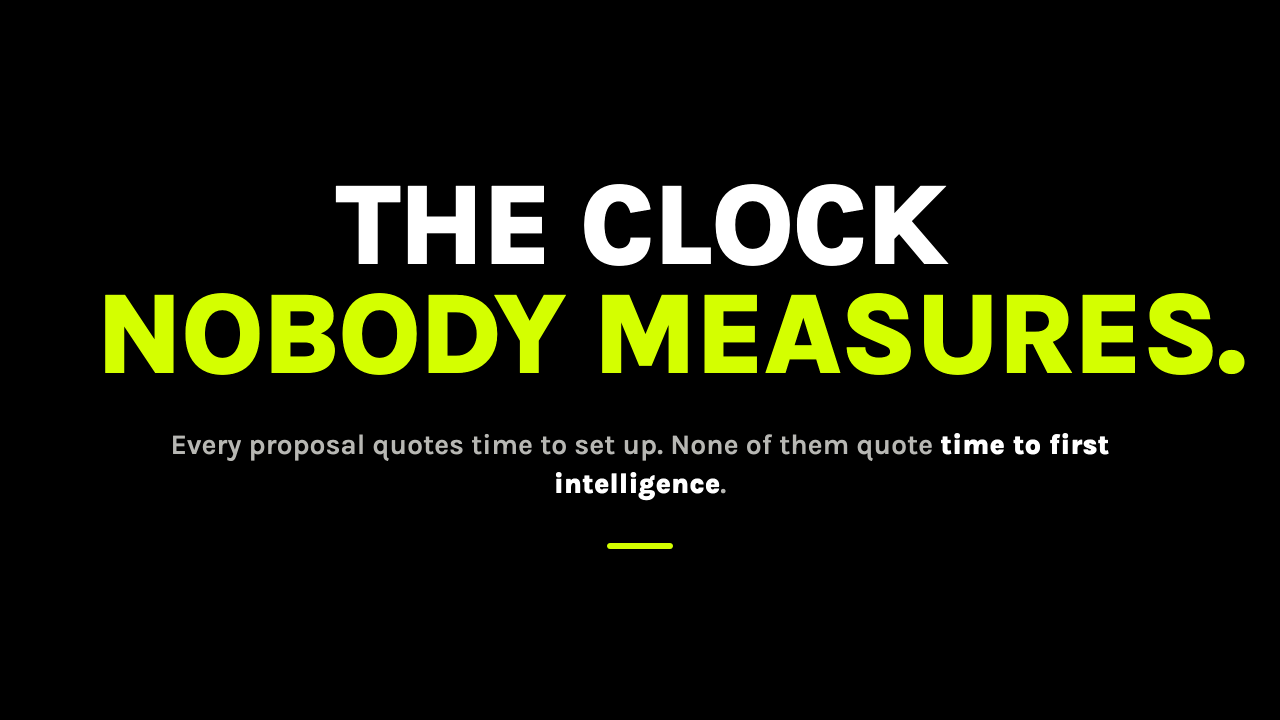
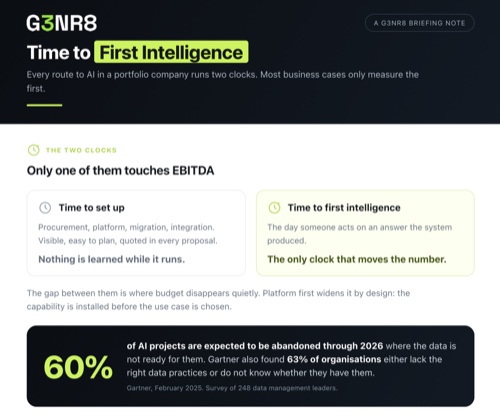
Whatever route a firm takes, there are two clocks worth measuring.
| Time to set up. Procurement, platform, migration, integration. Easy to plan, and quoted in every proposal. |
| Time to first intelligence. The day somebody acts on an answer the system produced. Rarely quoted, and the one that reaches EBITDA. |
Source: Clearlake
For a fund the value is not the foundation itself, it is how quickly a portfolio company can show a number that survives scrutiny. That argues for proving one lever on one asset early, in weeks rather than quarters, so the return is demonstrated before the programme scales rather than assumed. It also argues for keeping the model underneath swappable, a choice far cheaper to keep than to buy back later.
| | ||
|
The read: the blockers they name are people and operating model, not technology.
Rootstock found adoption close to universal, at 94%. The interesting part is what they say holds them back, and what they spend on next.
| The blockers named are a talent gap and poor cross-department working. Neither is a software problem, and both are fixable by an owner with a mandate. |
| 61% plan to increase enterprise software spending this year, and 49% want their next system to simplify what they already run. The budget exists, pointed at consolidation. |
Source: Rootstock 2026 State of Manufacturing Technology Survey (a vendor survey, methodology not published)
Manufacturers are short of neither budget nor intent. The blockers they name, talent and cross-department working, are operating-model problems, the category an owner can act on and a licence cannot. The fastest gains usually come from making the data a business already has work harder across teams, rather than adding another tool. The effect is felt as speed: a question that took a week gets answered the same morning, while the decision still matters.
an industrial manufacturer, in its own order book
The challenge. Thousands of accounts, and no reliable way to tell which had changed in any given week. Monthly totals looked steady. Underneath, some customers were slowing down and some were quietly being served at a worse price, and nobody could say which until it showed up in a quarter that had already closed. Reps knew their own accounts. Nobody could see the whole book.
What we did. Every account gets its own baseline. We read four signals against that customer's own normal: order rhythm, order volume, effective price and product mix. The score weights them by what hits revenue, flags what moved, and sends it to the named rep.
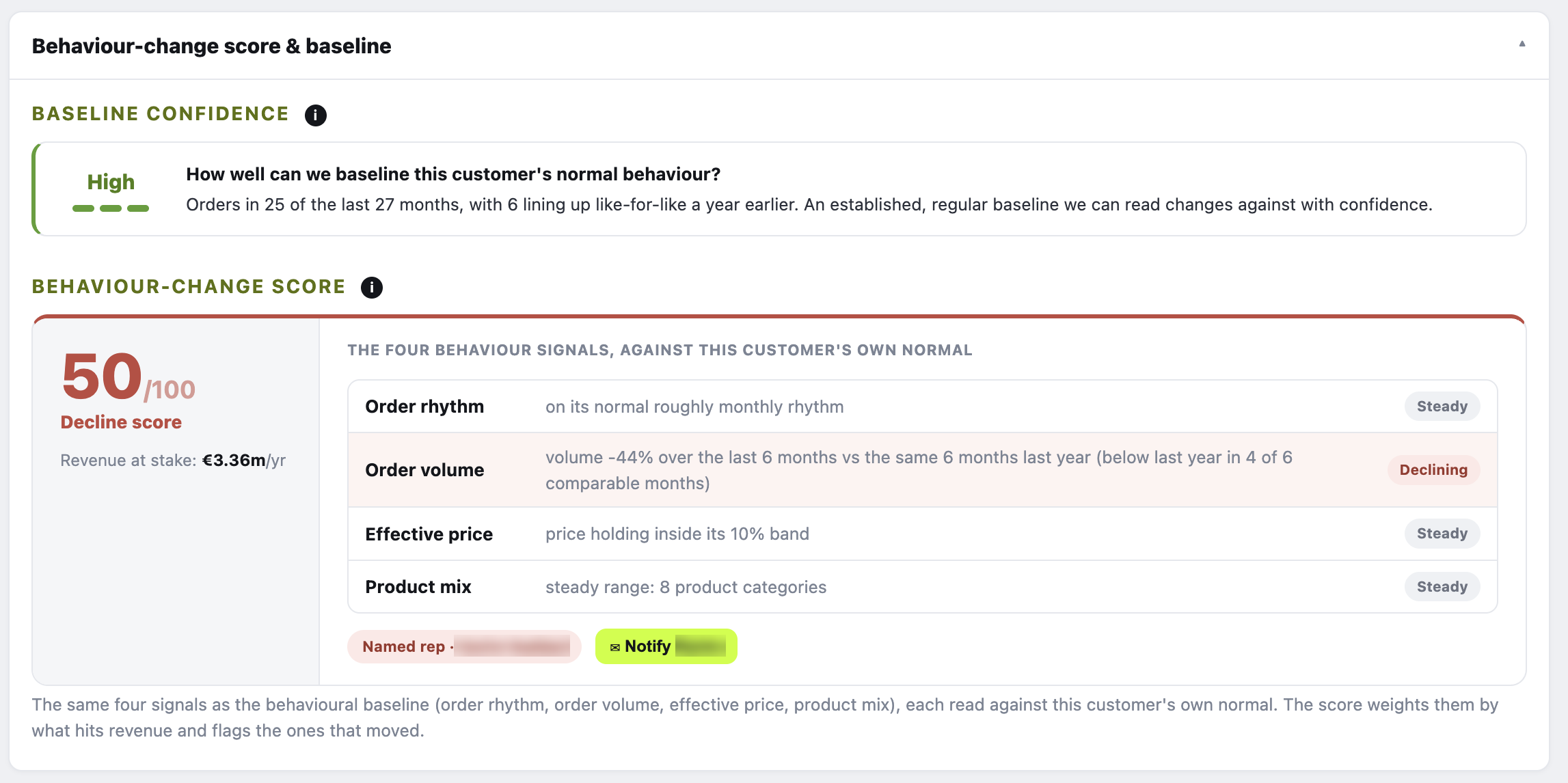
Why it works. A single rule is wrong for almost every customer it touches. A 20% drop is an emergency for one account and ordinary seasonality for another, and only that customer's own history tells you which. It also scores how confidently it can baseline each account, so thin, irregular ones are not treated like three years of steady ordering. That is what stops the team drowning in alerts.
Here the price signal surfaced effective price eroding across roughly 85% of revenue. More than EUR 3m a year, moving through as normal trading and invisible in the monthly totals.
EUR 3m+ a year of effective price quietly eroding across ~85% of revenue |
64% of revenue sat with the top 10% of customers, at the lowest price per unit |
1:1 a baseline per account, not one rule across the book |
The right person is told when to act, while there is still something to act on. For a portfolio company that lands in three places. Revenue protected, because accounts are caught while still winnable. Churn reduced, because the warning arrives in time. Margin expanded, because price erosion is visible per customer, not averaged into a number that looks acceptable.
Same asset, better instrumented, and more defensible to sell. Protected revenue and recovered margin are the multiple, the DPI and the next raise.
We're specialists in the order book
Order book intelligence for industrial manufacturers and distributors. Three questions, asked continuously of a company's own order data.
| Which revenue is about to leave. |
| Which margin is being given away. |
| What tasks can be automated. |
The usual blocker is the data. Gartner expects 60% of AI projects to be abandoned through 2026 where the data is not ready. The standard answer is a cleanup programme first: months of spending before anything is learned.
We do not require it to be ready. We connect to the systems a business already runs on, the ERP, the CRM, the spreadsheets and documents where the real detail lives. Nothing is migrated, no IT project on their side.
A consultancy leaves a recommendation and an invoice. We leave a system the sales team opens every morning. When it works, the tell is they open it less, because it brings them the decision.
| › | European Commission The AI Act is fully applicable from 2 August. The high-risk classifications most portfolio use cases fall under were deferred to December 2027. Worth checking which date your portfolio is being sold against. |
| › | Our own book In a European industrial distributor we identified EUR 45m of at-risk revenue in 6 weeks, then helped cut it by over EUR 10m in the next 4 weeks. Used daily by the sales team. |
Which revenue is about to leave?
Ask us for the free data read and we will scope a fast read of one portfolio company's own order data: which revenue is about to leave, which margin is being given away. Weeks, not quarters.
Ask us for the free data readThe uncomfortable findings are usually the valuable ones. We would rather hand you one early than a clean answer that does not hold.
Tom
P.S. Tell us what you want more of and we fold it into the next issue. Say what you want.
Keep informed with the newsletter for PE operating partners and the portfolio companies they back.
Get operational insights and trends, AI frameworks, resources and real deployment stories.
